Thursday, February 24, 2011

Guest Post: Tutoring Solutions

Today, we’d like to shine a light on the Tutor Resource Center at North Central State College in Mansfield, Ohio. The Tutor Resource Center is a central part of NC State’s Solutions program, a pre-enrollment program that is designed to help adult basic education and developmental education students move through dev ed and on to college-level courses more quickly. The college began with a logic model and evaluation plan, data collection, and a clear program for training and engaging tutors and faculty—all actions that demonstrate commitment to the Achieving the Dream core principles that DEI colleges are building on as they innovate. The description below comes from Barb Keener, NC State’s coordinator of tutoring services.

The Tutoring Resource Center has been a positive addition to North Central State College. The Tutor Resource Center is located in two adjoining classrooms; there are u-shaped tutor stations with one tutor at each station.  Students sit around the tutor, allowing the tutor to work with multiple students at the same time.  We have 24 tutors with strengths in a variety of areas. We employ students, faculty, and individuals from the community that hold various degrees. Peer tutors, or students, must be referred by a faculty member and must have earned a B or better in the course(s) they would like to tutor.

The development of a logic model, evaluation plan, and data template was useful in planning strategies to meet our goals. Using TutorTrac, a RedRock Software Corporation product, we are able to track and analyze traffic patterns for scheduling purposes, as well as planning the budget.  We are able to analyze student grades and attendance patterns to determine which areas we have been most successful and areas in which we need to improve.  We also use the software to communicate with faculty and the advising department.

A tutor training program is essential for an effective tutoring center. We have implemented a tiered program with three levels of certification: professional, advanced, and master tutor.  Tutors attend quarterly trainings, working toward the master tutor certification. When tutors work their way through the certification levels, they are rewarded with an increase in pay, motivating them to participate in trainings and improve tutoring methods. The development of a policies and procedures manual has helped us make consistent decisions and train new tutors. The manual is an easily accessible and very useful resource for tutors. 

While student success is our main focus, we have worked diligently to support the objectives of the faculty within the classroom. We have worked with faculty to determine how we can meet their needs as well as the needs of their students. We have open communication with faculty and frequently get both positive and negative feedback, allowing us the opportunity to grow and develop as a team and center. This collaboration is paying off. The following table shows that the Fall 2009 Solutions cohort had higher completion and persistence outcomes than a 2008 comparison cohort.


Solutions Data: Fall 2009 to Fall 2010
*Includes those testing out of a DevEd class while in Solutions

Wednesday, February 23, 2011

Guest Post: ATD/DEI State Policy Meeting Recap

Greetings from the Jobs for the Future ATD/DEI team! On February 8-9, 2011, we convened our state policy leaders and advocates in Indianapolis for our semi-annual ATD/DEI State Policy Meeting. During our two days together – and with an eye on student success – we applauded our recent achievements, revisited our initiative goals, and discussed how best to make progress given the current state policy environment.

As conversations with our states unfolded, we took care to recognize that the ongoing fiscal crisis and limited evidence on effective interventions pose serious challenges. We created a space in which our state policy leads could learn and share – and we worked with them to be well positioned to make smart choices over the next year and a half of work.

Highlights included:
  • Engaging and spirited dialogue during our plenary sessions on data-driven improvement, investments in innovation, and policy supports – followed by concurrent breakout sessions led by guest presenters, state policy team leaders, and JFF staff.
  • Presentations from higher education experts such as Kevin Dougherty and Shanna Smith Jaggars of the Community College Research Center, providing us with insight on the latest research evidence and its implications for policy.
  • A rousing lunchtime keynote from Uri Treisman of The University of Texas at Austin in which he targeted faculty development, well-executed modularization, and student surveys as proactive methods for improving student completion. 
  • Participation in a hands-on data exercise hosted by JFF’s Keith Brown, and Florida Department of Education’s John Hughes, spurring such questions as: How and why are some institutions more successful than others? How can we train staff and faculty to better understand and analyze data? And finally, how do we create a common language around data?
  • The emergence of topics that warrant increased attention at the state and institutional levels – including new approaches to performance funding, methods of better engaging faculty, and taking the data-use conversation to the next level.
Over the next 18 months, the DEI states are poised and ready to continue making great strides. We look forward to continuing these discussions at our summer convening in Miami from July 26-27, 2011. See you there!

Katrina Reichert is a project manager at Jobs for the Future.

Friday, February 18, 2011

GSCC's Jam on Teaching Dev Ed

If you’re a developmental ed practitioner and you haven’t checked out Global Skills for College Completion’s “Jam” on pedagogy, you should head over there right now!

The most active discussion is about using data and evidence to assess pedagogy (in contrast to assessing student learning). You can still contribute to the threads that began yesterday about institutional strategies, student context, and faculty attributes. The GSCC blog is keeping track of the highlights, which include ideas on curriculum contextualization, faculty adaptability, peer engagement, and creating a sense of community in the classroom.

The Jam ends tomorrow, so get into the conversation while you still can!

Alyson Zandt is a Program Associate at MDC.

Thursday, February 17, 2011

Green Light, Red Light

We discussed the February 8 DEI Pre-Conference Convening on the blog last week, but we wanted to lift up some reflections from the meeting participants. At the end of an intense day of problem solving, sharing, and collaboration, David Dodson, president of MDC, led the group through a red, yellow, and green light exercise. He asked participants to talk about:
  • what they learned that they’d like to immediately proceed with-- green light!
  • what things they’d like to examine with some caution--yellow light!
  • and anything they’d like to stop and reexamine--red light!
Participants gave the green light observations to creating more incentives for faculty to innovate in developmental education; high-stakes testing got a yellow light, and one-stop, non-systemic faculty development that is not part of long-term staff development got the red light signal for reexamination.

But let’s back the car up a bit. As the group was pulling up to the yellow light, one significant note of uncertainty arose: the absence of a working theory of what works for students at the lowest level of development. One meeting participant said, “we have opinions, biases, but not a working theory, and until then we’re shooting in the dark.”  The glaring caution here: an emphasis on scaling can provide an unintended disincentive to help students at the lowest levels, and focusing on students that have a shorter road to successful completion. 

This same issue got a red light of reexamination in today’s Inside Higher Ed. Arizona’s Pima Community College Chancellor, Roy Flores, discusses one response to this conundrum: his college is changing admissions policies. Students that test into the lowest level of developmental education will not be allowed to enroll, but will instead be referred to other adult education services in the college and community. Though budget constraints are part of the impetus, Chancellor Flores is chiefly concerned by data that show that “students testing into the lowest levels of developmental education have virtually no chance of ever moving beyond remedial work and achieving their educational goals.” 

Here again is the tension between the access mission and the student-success mission of community colleges. What do we need to learn and where do we need to innovate in order to build pathways to valuable credentials that meet the varied needs of individuals on that path?


Abby Parcell is MDC's Program Manager for the Developmental Education Initiative.

Monday, February 14, 2011

What Time is it? It's Valentimes!

xkcd

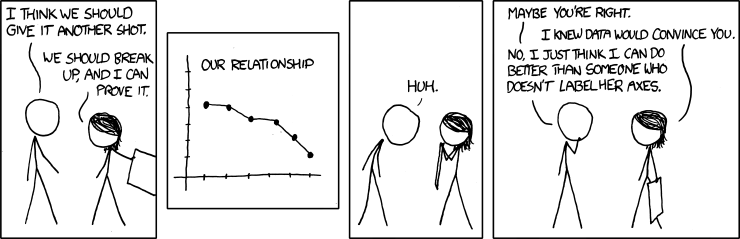
Just a reminder on this holiday to always remember the human side of data.

If you've had experiences like this one, check out these 7 Basic Rules for Making Charts and Graphs from FlowingData. 

Happy Valentine's Day from the DEI Team at MDC!